⚠️ Situation Escalating: Energy Infrastructure Under Attack — No Ceasefire in Sight
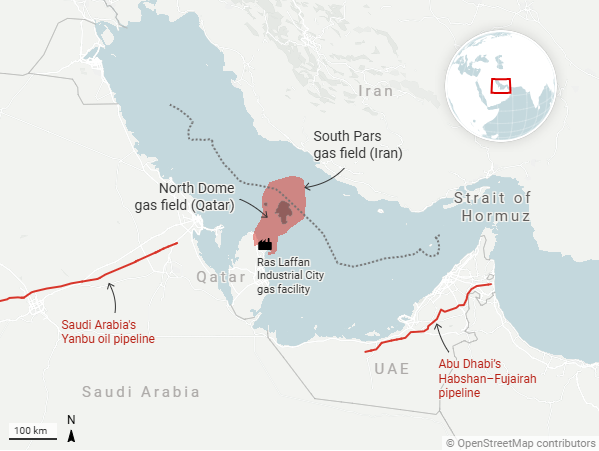
🔴 Military & Hormuz Status
- US–Israel air campaign enters week 4; bunker-buster strikes on Natanz nuclear facility and 90+ Kharg Island military sites (ISW 22 Mar)
- Trump issued a 48-hr Hormuz ultimatum threatening strikes on Iranian power plants; deadline extended but still active (1News 24 Mar)
- Iran threatening to "completely" close the Strait if conditions unmet; no ceasefire in sight Tehran experiencing major blackouts from Israeli strikes
⚡ Energy Infrastructure Hit
- Israel struck Iran's South Pars gas field & Asaluyeh processing complex (NYT 23 Mar; Le Monde 19 Mar)
- Iran retaliated against Qatar's Ras Laffan LNG hub, Kuwait, Saudi Arabia & UAE "extensive damage & large fires" reported (Reuters 19 Mar)
- Qatar energy minister: repairs up to 5 years; ~17% LNG export capacity cut, expansions delayed past 2027 (NYT 19 Mar)
- ~⅕ of global crude & gas supply suspended or severely disrupted; oil prices +40% since war began (WEF 20 Mar)
🔬 Semiconductor supply chain implication: Structurally lower global LNG capacity (notably Qatar) and persistent Hormuz closure risk are now the baseline, not a tail-risk. Elevated gas/power prices and volatile LNG availability for EU fabs and Asian chip hubs (Taiwan, South Korea) are effectively locked in for the medium term.
⚠️ Geopolitical Context — February–March 2026
- US–Israel vs. Iran conflict (started 28 Feb 2026): Large-scale airstrikes targeting Iran's nuclear program, IRGC bases, air defenses, and leadership. Supreme Leader Khamenei was killed; his son Mojtaba has been designated successor.
- Iranian retaliation: Iran is launching waves of missiles and drones at Israel, US bases, and all six GCC nations; the first time in history all Gulf states have been attacked simultaneously.
- Strait of Hormuz: Effectively closed to Western carriers. ~20% of global oil and ~22% of LNG transit disrupted. ~150–170 tankers stranded.
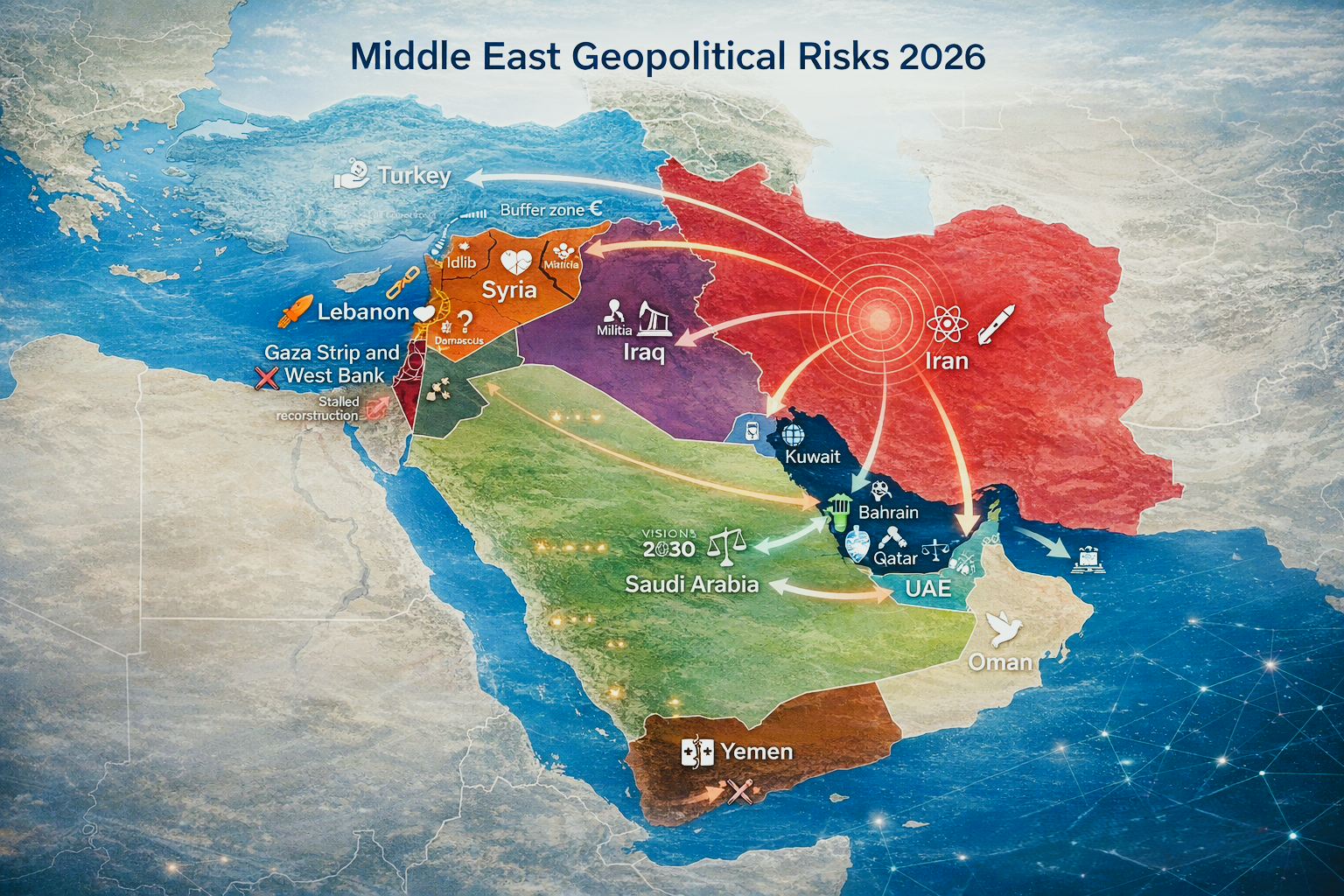
⚡ EU Energy Exposure — Key Figures
- Brent crude: Spiked to ~$115–120/bbl intraday; sustained elevated levels as Hormuz disruption persists.
- Dutch TTF gas: Jumped ~20–30% immediately after Qatar halted LNG production under Iranian drone attacks. EU gas prices forecast ~40% above pre-war paths through 2027 (HSBC).
- LNG from Hormuz: Qatar and UAE supply ~20% of global LNG; shipping has slowed to near standstill, forcing Europe into intense competition with Asia for spot cargoes.
- EU fab electricity costs: Already 2× US and Chinese levels in H1 2025; this shock adds further volatility at a moment when EU factories were at closure risk from energy costs alone.
- EC emergency response: European Commission is discussing energy price relief for heavy industry explicitly citing the Iran war-driven spike.
Net impact for EU chipmakers: Higher variable costs for ST, Infineon, NXP's EU sites, Intel's Irish/German builds, GlobalFoundries Dresden, and upstream suppliers (photoresists, fluorinated gases, silicon, CMP slurries, electronics-grade solvents) that may already be energy-marginal in Europe. This worsens the cost gap versus US and East Asia and may accelerate offshoring of marginal production steps.
100% Stacked Impact Assessment by cluster & Category
Each bar shows the relative share of Critical, High, Medium, and Low impact across key supply chain and fuel dimensions. Based on analyst consensus (Bruegel, CNBC, Bloomberg, Reuters) March 2026."AI Theoretical projection"
Energy Benchmark Price Index (Pre-War = 100)
Approximate index values relative to end-January 2026 baseline.
Shipping Route Status — Container Capacity Impact
Estimated share of normal capacity operating across key maritime corridors, March 2026.
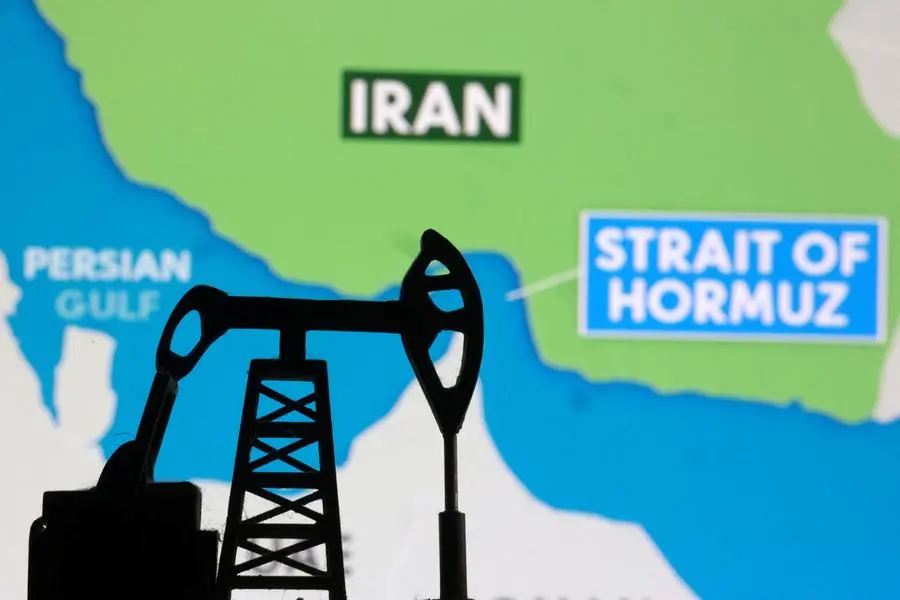
🚢 Hormuz Closure Impact
- Container traffic through Hormuz collapsed by ~90%
- Major carriers (Maersk, MSC, CMA CGM, Hapag-Lloyd) have suspended Gulf transits
- 150–170 tankers and container ships stranded in/near the strait
- War-risk insurance withdrawn; IRGC threats actively enforced
📦 Rerouting & Cost Surge
- Asia–Europe services rerouted around Cape of Good Hope: +8–15 days transit
- CMA CGM conflict surcharges up to $2,000/TEU on affected lanes
- Route diversions surged 360%+; schedule instability widespread
- ~13.6% of global airfreight capacity affected by Gulf airspace closures
⚙️ EU Semiconductor Logistics Impact
- Equipment, spares & materials from/via Asia face longer transit and schedule slippage
- Higher freight/insurance pushing up landed costs for fab capex
- Automotive/industrial suppliers at risk of missed launch windows
🌐 Asian Port Congestion
- Containers unable to unload in Gulf are piling up at Asian transshipment hubs (Singapore, Malaysia)
- 2% of global container fleet trapped in wider Gulf region
- Freight rates rising as effective capacity shrinks
🔬 Helium — The Single-Point-of-Failure Risk for Semiconductor Fabs
- Qatar supplies ~33% of global helium via Ras Laffan (up to 17 t/day liquid He). Iranian drone/missile attacks and Hormuz closure have effectively halted production and shipment.
- ~30% of world helium transits via Hormuz; that entire volume is now at risk.
- Spot helium prices surged ~50%; industrial gas suppliers (Linde, Air Liquide, Iwatani) adding surcharges with force-majeure scenarios being discussed.
- Semiconductor impact: Helium is critical for wafer cooling, EUV tool components, purge gas, and leak testing. EUV adoption by DRAM makers increases helium demand further.
- Logistics unforgiving: Liquid helium boils off; "catching up" ships takes weeks or months even after plants restart medium-term vulnerability is structural, not just a short shock.
- China response: Rapidly building ultra-high-purity domestic helium capacity and high-efficiency recovery systems as an alternative.
🏭 Fab Impact of Helium Shortage
- Higher OPEX per wafer at helium-intensive nodes (EUV, CVD/etch steps)
- Risk of throughput reductions or temporary line slowdowns if allocations tighten
- Pressure to expand helium recovery/reuse systems and shift where possible to nitrogen for non-critical purge steps
- European fabs face same pricing and allocation pressures as Asian peers — priority will go to medical, defense, highest-value logic
🌾 Sulphur — Indirect Risk via Fertilizers
- Gulf countries supply >50% of Asia's sulphur, phosphates, and 64% of ammonia
- War has shut/curtailed fertilizer & chemical facilities in Qatar and elsewhere
- Global fertilizer markets entering new volatility phase; sulphur supply a key pinch point
- Semiconductor indirect risk: sulphuric acid used in chemical processing, metals refining, and some electronics-grade acid steps
🧪 Bromine — Secondary Chokepoint
- ~⅔ of bromine supply comes from Israel/Jordan; Korea relies on this for ~90% of needs
- CNBC analysts explicitly warned: prolonged conflict could disrupt bromine directly, threatening production costs and continuity
- Short-term buffers exist but "adjustments in procurement" will be needed
- Bromine used in flame retardants, certain Lithography chemistries, and wafer processing steps
🇹🇼 Taiwan — Energy-Driven Fab Risk
- 97% energy imported; ~37% of LNG-heavy grid fuel from Middle East now jeopardized by Hormuz crisis
- Only ~11 days LNG reserves; officials say supplies covered through mid-May, but beyond that, sustained disruption threatens power security
- TSMC and peers are enormous continuous power loads. Any grid instability or rationing immediately impacts high-end logic and specialty nodes with no short-term substitute
- EU exposure: EU automotive, industrial & HPC customers risk de-prioritization if Taiwan must curtail output
🇰🇷 South Korea — Memory Dominance Under Threat
- ~70% of crude oil from Middle East, virtually all via Hormuz
- Samsung + SK Hynix = ~80% global HBM, ~70% of DRAM, any constrained output ripples worldwide
- $200B+ market cap wiped at peak sell-off; analyst concerns about sustained energy/materials disruptions constraining memory output
- DDR5 and HBM prices already spiking due to AI demand. Conflict amplifies tightness with no short-term substitute
- EU data-center, AI, automotive, and industrial OEMs face higher memory prices and potential allocation
🌐 Knock-On Effects for European Buyers
- European OEMs & system integrators are major downstream users of Korean memory in servers, automotive ECUs, industrial systems, and consumer electronics
- Supply squeeze or pricing spike in HBM/DRAM from Korea feeds immediately into EU data-center, automotive, and industrial equipment costs
- Even without physical outages, market panic drives procurement decisions, risk of over-ordering panic or under-ordering if price trajectory is uncertain
- Energy–semiconductor coupling thesis (Carnegie): Securing chip leadership now requires securing the energy system powering fabs. TSMC's 100% renewable-electricity pledge by 2040 is the benchmark
- For Europe: without predictable, competitive low-carbon power, EU fabs and materials expansions face persistent cost headwinds and external shock vulnerability
Israeli Civilian R&D Shift Under War Conditions
- Israel's high-tech base remains large, but wartime mobilization and uncertainty are slowing parts of non-military innovation.
- Engineering talent and capital are being redirected into defence electronics, missiles, drones, and air-defence programs.
- SMEs and early-stage civilian ventures face tighter financing, staffing gaps, and weaker domestic demand.
- Net effect: no collapse, but a compositional shift toward defence/security tech and slower civilian R&D throughput.
EU Cooperation Risk: Political & Reputational Drag
- Public boycott and divestment pressure in parts of Europe is increasing scrutiny of visible non-defence cooperation with Israeli entities.
- Some governments are differentiating settlement-linked activity, while broader defence procurement from Israeli firms continues.
- Universities, public research bodies, and state-linked actors face higher compliance and ethics checks for new joint projects.
- Expected outcome: slower approvals and more friction for public-facing EU-Israel R&D, while lower-profile private B2B ties can still proceed.
🚗 Automotive & Mobility
- cluster is both energy-intensive and dependent on petrochemicals & maritime logistics
- Brent above $100 raises fuel costs and thus ICE vehicle total cost of ownership; plastic/rubber input costs higher
- For EU carmakers: higher energy + material costs, more expensive imported components via Suez/Hormuz
- Potential demand softness if consumers face higher fuel and food inflation translates into more cautious semiconductor ordering
- Still working through electrification transition and prior chip-shortage scars
🏗️ Industrial Equipment & Machinery
- Eurozone industrial output was already weak entering 2026
- New energy-driven cost pressure "hampering industry" worsens margins in energy-intensive sectors
- EU heavy industry (chemicals, metals, glass, some electronics) explicitly lobbying for electricity relief
- Some customers may delay/phase capex as operating costs rise and macro uncertainty increases
- Medium-term electrification & efficiency drives still support structural demand for industrial semis
📱 Consumer Electronics & ICT
- Higher energy and food bills reduce disposable income for electronics, smartphones, PCs, and gadgets
- Food cost inflation is cited explicitly in Iran war analyses as an amplifying factor via oil-driven transport/logistics costs
- AI and cloud demand remains structurally strong, but Korean/Asian energy shock would immediately hit EU data-center build-outs
- PC/smartphone cycles were stabilizing, conflict mutes near-term demand recovery
- EU hyperscalers face higher component costs if HBM/DRAM prices spike further
Based on a "prolonged but contained" war assumption: Hormuz constrained for months, energy elevated, but no Taiwan-Strait war or nuclear escalation. Sources: Bruegel, HSBC, IDC, Bloomberg, The Economist.
Near-Term Pressures
- EU gas prices ~40% above pre-war projections; high energy cost floor persisting
- Helium and bromine buffers (~several months) protecting fabs short-term
- Memory tightness and higher prices: "tightness and higher prices," not hard outages
- Logistics lead times extended +8–15 days, freight costs elevated
- EU fab expansions facing margin pressure; some capex may be postponed
- IDC: measurable but moderate IT-spend impact if fighting & shipping risk persist into H2
Structural Cost Floor Sets In
- HSBC: EU gas prices structurally ~40% above pre-war paths through 2027
- Bloomberg: Hormuz chokepoints "cast doubt on global chip supply" if war drags on
- Permanent contract reshuffling for helium, bromine-linked chemistries at higher prices
- EU fabs and upstream materials less cost-competitive vs. US/Asia, risk of offshoring marginal steps
- Higher chip prices and tighter allocation from Korea/Taiwan for critical nodes and memory
- EU OEMs pressured to redesign for multi-sourcing or accept longer lead times and higher buffer stocks
Scenario-Dependent Legacy
- If resolved quickly: Most damage fades; main legacy is faster regionalisation, more LNG contracts, higher strategic inventories
- If prolonged: EU energy cost gap vs. US/Asia structurally entrenched, weakening EU's competitive chip manufacturing position
- Possible helium shock forcing permanent process changes and potentially capping output at advanced nodes for several quarters
- Possible Taiwan/Korea power crisis with multi-quarter knock-on effects in AI & automotive
- Military semiconductor demand increases; consumer general-purpose IT demand stagnates under high energy/inflation
Key Failure Modes × Time Horizon (Probability / Impact Assessment)
Based on analyst consensus. Impact scale: Low = manageable, Medium = costly, High = material disruption, Critical = systemic.
| Risk / Failure Mode | Now (Mar 2026) | 6 Months (Sep 2026) | 12 Months (Mar 2027) | 24 Months (Mar 2028) |
|---|---|---|---|---|
| EU Energy Cost Gap vs. US/Asia for fab ops |
HIGH Already active |
CRITICAL 40% above baseline |
CRITICAL Structural floor |
HIGH If resolved |
| Global Helium Shock Fab throughput risk |
HIGH Buffers depleting |
CRITICAL ~2wk to shortage |
HIGH Permanent restructure |
MEDIUM Recovery underway |
| Logistics Chokepoints Asia–EU lead times +8–15d |
CRITICAL 90% Hormuz drop |
HIGH Cape rerouting active |
MEDIUM Adapting routes |
LOW If war resolved |
| Taiwan LNG/Power Shock TSMC production at risk |
HIGH 11-day LNG reserve |
CRITICAL Post-May if sustained |
HIGH Depends on war duration |
MEDIUM Structural fix underway |
| Korean Memory Price Spike HBM/DRAM supply tightness |
HIGH $200B+ sell-off |
HIGH AI demand amplifies |
MEDIUM Market adapts |
LOW–MED Investment response |
| EU Automotive Demand
Drop Semiconductor ordering cut |
MEDIUM Cautious ordering |
HIGH Inflation + oil drag |
MEDIUM | LOW Structural EV trend |
Mitigation is possible, but mostly about buying time and reducing single-points-of-failure. Large fabs report no immediate disruption yet due to existing diversification and inventory buffers, but the clock is ticking.
Materials: Diversified Sourcing & Contracts
Large fabs (TSMC, SK Hynix, Samsung, GloFo) have already diversified helium suppliers and signed longer-term contracts after prior crises, explains why no immediate disruption yet. Korean firms have started recycling part of helium consumption; China rapidly building domestic ultra-high-purity helium capacity.
Materials: Inventory Buffers
Korean and Taiwanese memory makers hold several months of inventories for key materials (helium, bromine). Analysts currently see "little or no risk" in the very short term because of these buffers, but a prolonged disruption beyond weeks will deplete them.
Helium Recovery & Recycling Systems
Chipmakers expanding helium-recovery and reuse on-site. Partial mitigation for non-EUV steps; nitrogen substitution in some purge/cooling roles where process tolerances allow. High-efficiency recovery reduces per-wafer consumption but cannot fully replace primary supply for critical EUV steps.
Energy Security: Grid Upgrades & Renewables
Korea's Yongin chip cluster getting dedicated 3 GW transmission lines. For Taiwan, Korea, Japan & EU: more long-term LNG contracts outside Gulf, faster renewables build-out, regulatory changes for chip clusters to connect to secure domestic power. TSMC's 100% renewable-electricity pledge by 2040 is the benchmark.
Logistics: Route Diversification & Safety Stocks
Manufacturers and 3PLs actively rerouting freight from Hormuz via Cape of Good Hope or rail/air for critical tools and high-value devices. OSATs, EMS, and OEMs raising buffer stock levels and splitting flows between multiple logistics hubs (Asian and European ports/airports).
Policy: Resilience-Oriented Industrial Strategy
The Iran war is strengthening arguments for: regionalizing some back-end/specialty capacity, maintaining strategic inventories of gases/chemicals, building shared EU emergency stocks. Government chip firm coordination intensifying (Korea ministry meetings with Samsung, SK Hynix on Middle-East-linked dependencies).